
Introduction
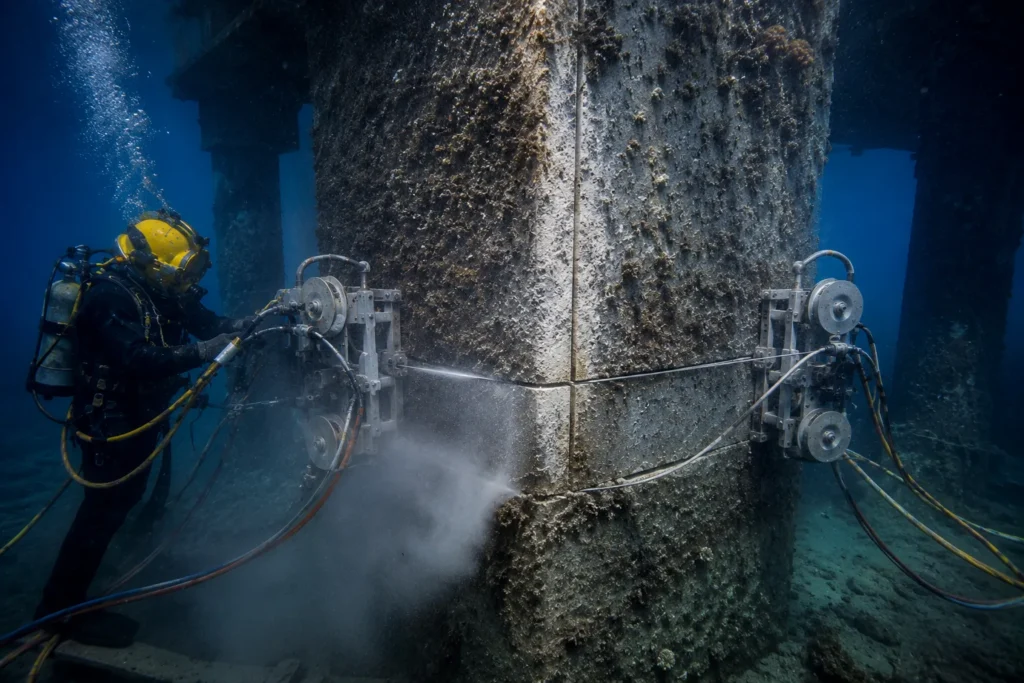
Wire Sawing has become one of the most effective methods for cutting submerged concrete, steel, and reinforced structures in marine environments. Modern marine construction projects rely on precision cutting techniques that minimize environmental disruption while maintaining safety and efficiency. Unlike traditional demolition methods, underwater wire sawing delivers controlled cuts without generating excessive vibration or shock loads.
Marine infrastructure across the United States continues to age. According to the American Society of Civil Engineers, many ports, bridges, and waterfront structures require rehabilitation or replacement. Contractors increasingly choose wire sawing because it can handle large structural elements with exceptional accuracy. Diamond wire systems can cut concrete sections exceeding 10 feet thick while maintaining clean edges and predictable results.
We regularly see wire sawing used during bridge rehabilitation, offshore platform removal, port expansions, and underwater utility projects. The method reduces project downtime and limits damage to surrounding structures. Its ability to operate in confined underwater environments makes it valuable for challenging marine conditions.
As marine construction standards continue to evolve, underwater wire sawing remains a critical solution for contractors seeking safe, precise, and cost-effective cutting methods.
Why Wire Sawing Is Essential for Marine Construction
Precision Cutting in Challenging Environments
Marine construction projects often involve structures located below the waterline where traditional equipment cannot operate effectively. Wire sawing uses a diamond-coated cable that travels around pulleys and guide systems to cut through concrete, steel, and composite materials.
The biggest advantage is accuracy. Contractors can remove specific sections without affecting adjacent components. This precision is particularly important when repairing bridge piers, dock foundations, and seawalls. Controlled cutting reduces structural stress and preserves surrounding infrastructure.
Key benefits include:
- Minimal vibration during cutting.
- Reduced risk of structural cracking.
- Ability to cut reinforced concrete.
- Effective operation in confined underwater spaces.
- Lower environmental impact than explosive demolition.
These advantages make wire sawing one of the safest underwater cutting methods available today. See how we help with the Impact of Marine Construction on Ocean Ecosystems.
Bridge Pier and Foundation Rehabilitation
Supporting Critical Infrastructure Repairs
Bridge structures require periodic maintenance to ensure long-term safety and performance. Underwater foundations often suffer from corrosion, scour damage, and concrete deterioration. Wire sawing allows contractors to remove damaged sections without compromising structural stability.
During rehabilitation projects, crews use wire sawing to cut deteriorated concrete around support columns and foundations. The technique creates smooth, precise cuts that simplify replacement work. Large concrete sections can then be lifted and removed by cranes or barges.
Recent transportation infrastructure projects have demonstrated that precise underwater cutting can reduce rehabilitation timelines by up to 30% compared with traditional mechanical demolition methods. Faster completion reduces traffic disruptions and lowers project costs.
The method also improves worker safety because operators can control cutting equipment remotely from support vessels or nearby platforms.
Offshore Platform and Marine Structure Removal
Efficient Decommissioning Solutions
Many offshore oil, gas, and renewable energy structures eventually reach the end of their operational life. Decommissioning these facilities requires precise removal techniques that comply with environmental regulations.
Wire sawing is frequently used to separate platform legs, support beams, and foundation components below the waterline. The process creates clean cuts that facilitate controlled lifting and disposal operations. Unlike underwater blasting, wire sawing produces less disturbance to marine ecosystems.
Common structures removed using wire sawing include:
- Offshore oil platform foundations.
- Wind turbine support structures.
- Subsea pipeline supports.
- Marine loading terminals.
- Harbor construction elements.
Environmental agencies often favor methods that minimize noise pollution and sediment disruption. Wire sawing helps contractors meet these requirements while maintaining project efficiency.
Port, Harbor, and Seawall Reconstruction Projects
Modernizing Marine Facilities
Ports and harbors handle millions of tons of cargo annually. Aging infrastructure requires upgrades to accommodate larger vessels and increasing freight volumes. Underwater wire sawing plays a major role in these modernization projects.
Contractors frequently use wire sawing to remove damaged quay walls, dock sections, and seawall components. Precise cutting allows selective removal while preserving usable portions of existing structures. This approach reduces material waste and lowers reconstruction expenses.
| Marine Project Type | Primary Wire Sawing Application | Key Benefit |
|---|---|---|
| Bridge Rehabilitation | Pier and foundation removal | Precise structural repair |
| Offshore Decommissioning | Platform leg cutting | Controlled dismantling |
| Harbor Expansion | Dock and quay wall removal | Reduced disruption |
| Seawall Reconstruction | Damaged concrete removal | Faster replacement |
| Utility Installation | Access openings and trenches | Accurate excavation |
The growing demand for resilient coastal infrastructure continues to increase the use of underwater wire sawing across major marine construction projects.
Conclusion
Underwater Wire Sawing has transformed how marine contractors approach complex cutting and demolition tasks. Its ability to deliver precise, vibration-free cuts makes it ideal for bridge rehabilitation, offshore platform removal, harbor upgrades, and seawall reconstruction. The method improves safety, reduces environmental impact, and supports efficient project execution in challenging underwater conditions.
As marine infrastructure continues to evolve, contractors need reliable technologies that balance performance with sustainability. Wire sawing provides that balance by offering exceptional cutting accuracy while protecting surrounding structures and marine ecosystems. For modern marine projects requiring controlled underwater demolition and structural modification, wire sawing remains one of the most trusted and effective solutions available.