
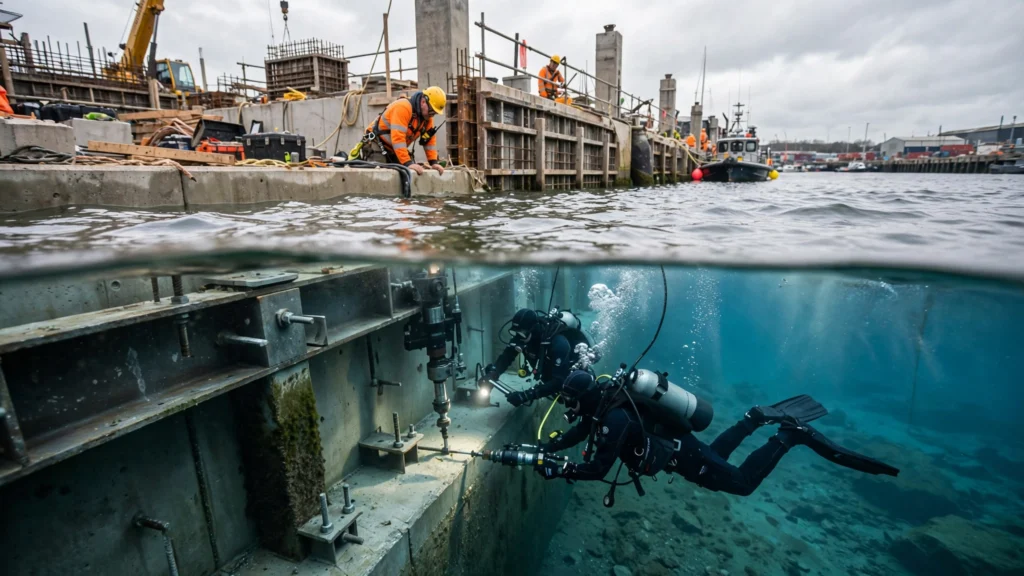
Quay Construction depends on professional diving teams to complete critical underwater work safely and efficiently. These specialists inspect foundations, install structural components, and support repairs that heavy equipment alone cannot perform. Their expertise helps projects stay on schedule while protecting workers, marine ecosystems, and valuable infrastructure.
Modern waterfront developments require precision below the waterline. Professional divers combine engineering knowledge, advanced underwater tools, and strict safety procedures to complete tasks in challenging conditions. Their role extends from early site investigations to final inspections, making them an essential part of successful Quay Construction projects worldwide.
Understanding the Role of Professional Diving Teams
Why Underwater Expertise Matters
Professional diving teams perform specialized underwater operations that directly support Quay Construction. Before construction begins, divers inspect the seabed, identify hidden obstacles, and verify underwater conditions. Their findings allow engineers to refine designs and reduce unexpected construction delays.
Unlike remote equipment, trained divers can assess structural conditions in real time. They communicate directly with surface engineers and adjust their work as conditions change. This flexibility improves decision-making and reduces costly errors during marine construction.
Core Responsibilities
Professional diving teams typically handle:
- Underwater inspections and condition surveys.
- Foundation verification.
- Pile installation support.
- Welding and cutting operations.
- Concrete placement monitoring.
- Structural repairs.
- Environmental assessments.
- Final quality inspections.
How Divers Support Every Construction Phase
Site Investigation Before Construction
Every successful Quay Construction project begins with accurate underwater data. Divers inspect seabed materials, measure sediment depth, and identify existing utilities or submerged debris. These inspections reduce project risks before heavy construction equipment arrives.
Divers also verify sonar and hydrographic survey data. Direct visual confirmation provides greater confidence when planning pile locations, retaining walls, and structural foundations.
Construction Support During Installation
During active construction, professional divers guide underwater installations with remarkable accuracy. They monitor pile driving, inspect reinforcement cages, and ensure structural elements remain properly aligned.
Divers also assist crane operators by providing underwater observations that cameras often cannot capture. Their communication improves installation precision and reduces the likelihood of expensive corrections later.
Essential Diving Equipment Used in Marine Projects
Advanced Technology Improves Accuracy
Modern Quay Construction relies on advanced diving equipment that enhances both safety and productivity. Commercial divers use specialized systems designed for extended underwater operations.
Common equipment includes:
| Equipment | Primary Purpose | Project Benefit |
|---|---|---|
| Surface-supplied diving systems | Continuous breathing air | Longer working periods |
| Underwater communication systems | Voice communication | Better coordination |
| Hydraulic power tools | Cutting and drilling | Increased productivity |
| Underwater cameras | Visual inspections | Accurate documentation |
| Sonar imaging devices | Low-visibility navigation | Improved safety |
| Lift bags | Heavy object movement | Reduced equipment costs |
This technology allows divers to perform complex underwater tasks with greater efficiency while maintaining high quality standards.
Safety Standards Protect Workers and Infrastructure
Strict Procedures Reduce Risk
Safety remains the highest priority in Quay Construction diving operations. Commercial diving companies follow detailed procedures established by international safety organizations and national occupational regulations.
Before every dive, teams conduct hazard assessments, review emergency plans, inspect equipment, and monitor weather, tides, and water currents. These precautions reduce operational risks while protecting both personnel and project assets.
Continuous Training Builds Expertise
Professional divers receive extensive training in underwater construction, emergency response, welding, inspection techniques, and confined-space operations. Many also earn certifications for non-destructive testing and underwater engineering inspections.
Experienced dive supervisors coordinate every operation. Their leadership ensures compliance with project specifications while maintaining safe working conditions throughout construction.
Inspection and Maintenance After Construction
Long-Term Infrastructure Protection
Professional diving teams remain important even after Quay Construction finishes. Regular underwater inspections detect early signs of corrosion, erosion, marine growth, or structural movement before problems become severe.
Preventive maintenance extends infrastructure life and reduces repair costs. Early detection often prevents small defects from developing into major structural failures.
Inspection programs commonly evaluate:
- Foundation stability.
- Concrete deterioration.
- Steel corrosion.
- Joint integrity.
- Marine organism growth.
- Scour around piles.
- Protective coating condition.
- Structural alignment.
These inspections support informed maintenance planning and improve long-term asset performance.
Environmental Responsibility During Marine Construction
Protecting Marine Ecosystems
Modern Quay Construction balances infrastructure development with environmental protection. Professional divers monitor sediment movement, identify sensitive habitats, and verify compliance with environmental permits throughout construction activities.
Divers can inspect work areas without creating unnecessary disturbance. Their direct observations help contractors minimize impacts on fish habitats, coral communities, shellfish beds, and underwater vegetation.
Environmental monitoring also supports regulatory compliance and strengthens public confidence in responsible waterfront development.
Expert Perspective on the Value of Diving Teams
Human Expertise Still Matters
Although remotely operated vehicles continue to improve, experienced commercial divers remain essential for many underwater construction activities. Engineering professionals consistently recognize that divers provide immediate judgment, precise manual skills, and direct problem-solving capabilities that automated systems cannot fully replace.
Industry experience shows that combining advanced technology with skilled professional divers produces stronger inspection results and more efficient marine construction. Divers adapt quickly to changing underwater conditions while maintaining construction quality and safety standards. Their practical expertise helps contractors avoid delays, improve installation accuracy, and protect valuable infrastructure investments over the entire project lifecycle. Explore our latest insights in Common Applications of Underwater Wire Sawing.
Conclusion
Professional diving teams form the foundation of successful Quay Construction projects. Their underwater expertise supports inspections, installation, maintenance, safety, and environmental protection. By combining technical skills with advanced equipment, these specialists help deliver durable waterfront infrastructure that performs reliably for decades while meeting modern engineering and regulatory standards.